
 €
€ Hiking
  Camping
  Trail
Trail  Running
  Mountaineering
  Climbing
  Mountain biking
  Road biking
  Survival
  Canyoning
  Alpine Skiing
  Ski touring
  Snow activities
  Snowboarding
  Cross-country skiing
  Lifestyle





Trail: is it better to walk or run uphill?
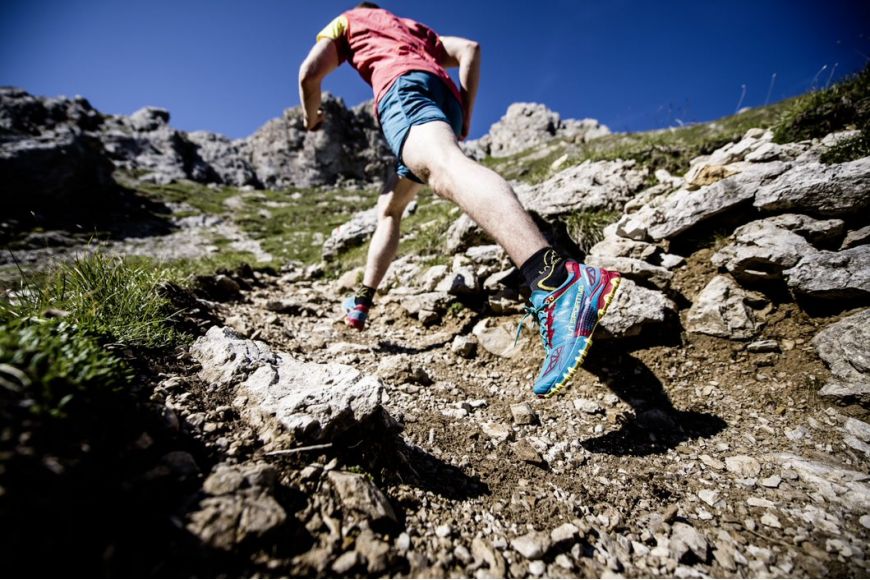
The debate haunts you before every training or race: should you favor walking or running uphill? Here, La Sportiva ambassador and professor Nicola Giovanelli shares a scientific and pragmatic perspective. We speak the truth, no bullshit: what works on paper must hold up on the trail.
On the ground, you've already seen the spectacle: some athletes walk, others run, and yet they move at the same speed. This observation has a simple explanation related to the economy of effort. On flat terrain, the transition from walking to running occurs between 6 and 8 km/h: beyond that, running becomes more efficient. But uphill, the game changes.
If you're looking for the complete key term, know that the question "walk or run uphill trail outdoor" often comes up in our exchanges with the community: it nicely summarizes the quest for efficiency and the choice of equipment that goes with it.
Let's take a typical vertical kilometer: 1,000 m of elevation gain over 3 km. The best take about 30 minutes (6 km/h), while others take around 60 minutes (3 km/h). At these speeds, walking often proves to be the most economical solution. Laboratory studies confirm: walking at a steep incline consumes less energy than running at the same speed.
Quick conclusion: if running doesn't allow you to significantly increase your speed, walk. And above all, train to walk fast uphill. It's a technical gesture that requires practice, like climbing in mountaineering or a mountain step in fast hiking.
How to walk uphill to be more efficient?
Technique matters. To maximize efficiency, you should: slightly lengthen your strides, maintain a fast cadence, and use your upper body to assist. If you don't have poles, push with your hands on your thighs and engage your arms. If you use equipment, choose suitable and lightweight poles to break up the effort.
We recommend integrating specific sessions: long climbs at ease, short steep repetitions at intensity, and especially race simulation. Walk uphill during certain sessions if you want to be ready on the big day: prepare your muscle fibers, work on your breathing, learn to manage effort.
In practice, a few simple rules: keep your torso slightly bent, look 5 to 10 m ahead, avoid dragging your back leg, and maintain cadence. On long ascents, mentally break it down: one summit at a time, one step at a time. Efficiency comes from rhythm and energy management more than from an attempt to sprint on false flat ascents.
- technique: controlled long strides, fast cadence
- preparation: integrate fast walking sessions uphill
- equipment: optimize support with poles if needed
Science confirms it: on slopes between 20% and 80% incline, walking consumes less energy than running at the same speed. This is a physiological reality that applies from vertical races to ultra-technical ones. But caution: effective walking requires practice. The quality of support, the placement of the center of gravity, and the economy of movement make the difference.
And what about the equipment? Don't underestimate the impact of good gear. To improve your weight/power ratio, AlpinStore selects and tests products in the field. Think about components that facilitate rapid ascent: shoes with good grip and support, lightweight and stable packs, practical belts for hydration, and suitable poles to redistribute the load.
In this perspective, we offer a range designed by and for practitioners: shoes with optimized grip for roots and rocks, packs that remain stable on slopes, and breathable textiles to wick away sweat during sustained ascents. We also offer a high-performance trail equipment suitable for technical ascents and descents.
To help you choose, here are some concrete guidelines. If you want to gain efficiency uphill, focus on reducing weight, stabilizing your pack, and maintaining a regular cadence. Don't hesitate to test in real conditions: theory must be validated on the trail.
- plan the essentials: hydration, quick nutrition, protections according to the weather
- test your equipment in training: adjust belt, pack stability, and shoes
In our store, you'll find high-performance trail poles designed for technical ascents, and trail belts for demanding runners that allow you to quickly access gels and flasks without breaking your stride. For those looking to optimize their rear support, we test trail packs from the best brands offering support and lightness.
The choice of shoes is crucial: high-performance trail shoes give you confidence on unstable ground, reduce unnecessary energy expenditure in stabilization, and promote effective propulsion. On the textile side, a well-thought-out trail clothing collection helps you regulate temperature without weighing you down.
If you also practice road or off-piste, integrate a high-performance running setup for your fast sessions, so you don't sacrifice stride quality on flat terrain. But remember: uphill has its specific laws: efficiency is key.
Wondering how to choose your setup to optimize ascents and descents? Nothing magical: test, compare, and listen to your body. At AlpinStore, we help you choose your trail equipment with honest advice tested by our team of seasoned athletes.
In conclusion: walk uphill if running doesn't increase your speed; train to walk fast, optimize your equipment, and work on technique. It's often this small systematic gain uphill that will save you precious minutes in the race. As our passionate customers say: the mountain deserves respect, we prepare our legs and our equipment with the same rigor.
author: Nicola Giovanelli
translated from English to French by the technical team of SAS AlpinStore.

Hello, Neat post. There's a problem with your web site in web explorer, may test thisK IE still is the market leader and a large component to people will leave out your magnificent writing due to this problem. gddefbedaddefgdd