€
€ Hiking
  Camping
  Trail
Trail  Running
  Mountaineering
  Climbing
  Mountain biking
  Road biking
  Survival
  Canyoning
  Alpine Skiing
  Ski touring
  Snow activities
  Snowboarding
  Cross-country skiing
  Lifestyle





Every respectable climber knows that climbing shoes are a product to choose very carefully and much more than a harness. The shoe should be like a second skin over your foot to achieve maximum sensation. There are many questions when buying climbing shoes, especially when it comes to our first purchase! What elements should be considered to make the right choice? What shape? What rubber? What is the most suitable shoe for my practice? ....
Here are our tips for choosing your climbing shoes well!
Everything you need to know about climbing shoes!
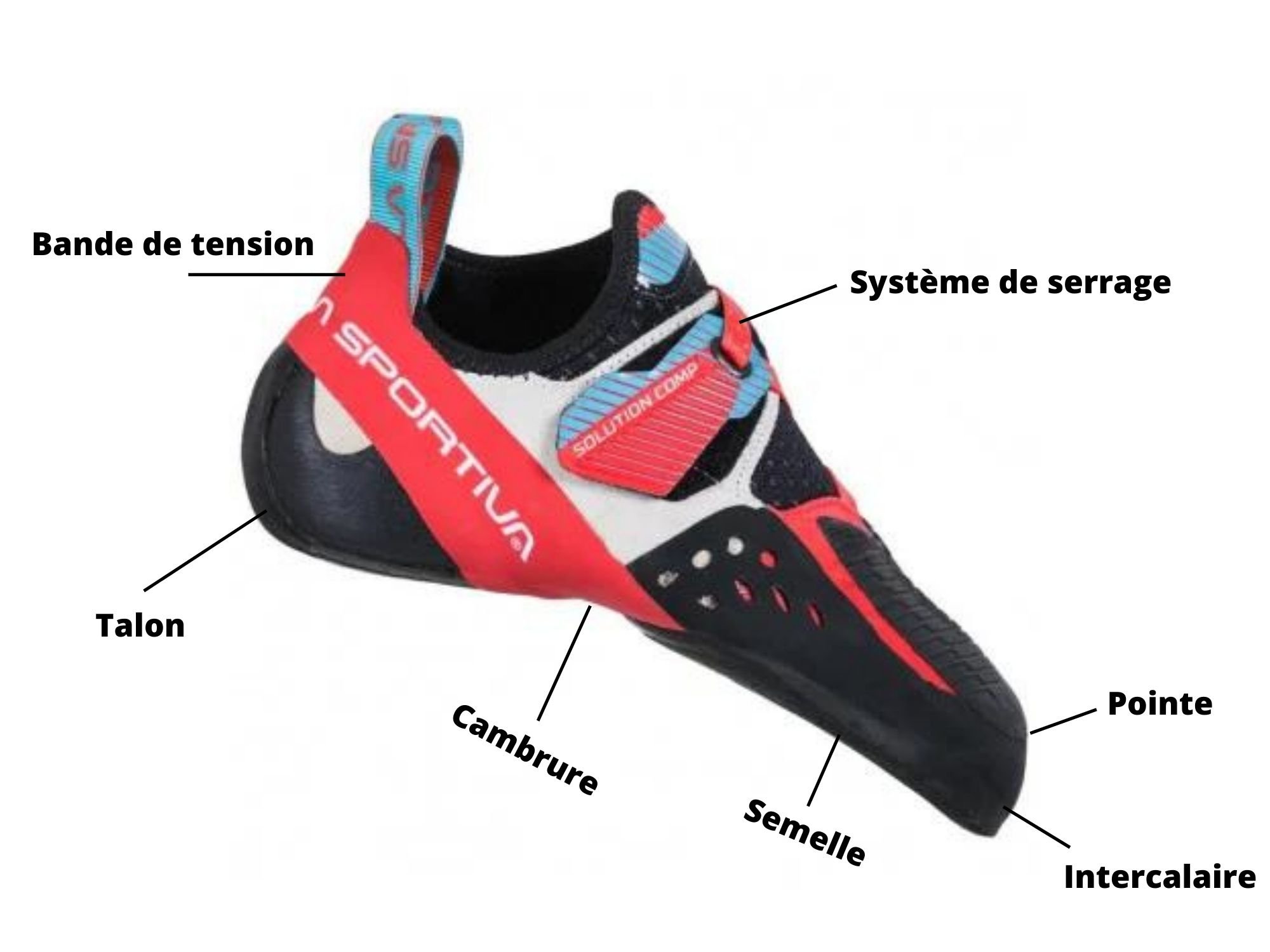 |
The sole
The essential element found in the sole is the rubber. It serves as both a contact surface (thus providing grip with footholds) and an element of rigidity for the shoe.
It is therefore the true master piece of the shoe. Today, generally speaking, all manufacturers provide quality rubber. Many use Vibram rubber, which is a reference for maximum grip.
The camber
The stronger the camber, the more technical the shoe will be.
In use, on overhangs and boulders, the shoe is arched and flexible to allow pushing on holds and working in adherence or flat on volumes.
Rigid climbing shoes are perfect for beginners or slab climbing to load on small holds while tiring the feet and calves less.
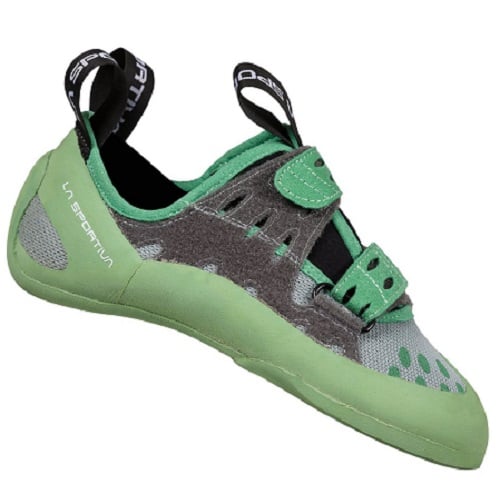 EXAMPLE OF CAMBER SUITABLE FOR A BEGINNER | .jpg) EXAMPLE OF CAMBER SUITABLE FOR BOULDERING OR OVERHANGS |
The heel
Here is a delicate point: you must ensure that your heel does not move in any situation. You should feel when you push on the toe, a tension that stiffens the whole by pulling on the heel. It is also important to check that it does not rise too high to avoid cutting into your ankles. This sensation is not necessarily very pleasant. If you experience this, it is likely because you have chosen a size that is too large.
The closure
There are different closure systems. Namely, Velcro, laces, and slippers.
| Velcro Advantage? Easier to put on or take off. | Laces Advantage? They offer the most precision | Slippers Often the most difficult to put on if you want to maintain a precision similar to the other two closure modes |
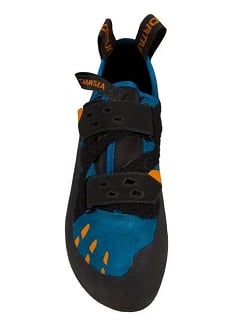 | 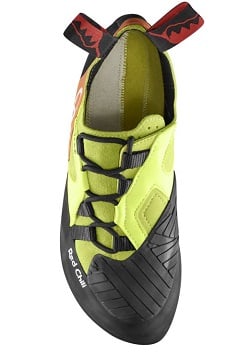 | 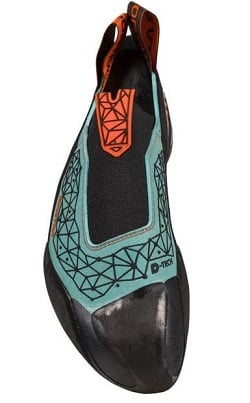 |
The toe
It is essential to take into account the morphology of your feet when choosing your climbing shoes.
A pointed toe will provide precision but sacrifices comfort.
Choosing your shoe based on the morphology of your foot
The shape of your foot is the first aspect to consider for your climbing shoe to achieve the best possible grip.
There are 3 foot shapes:
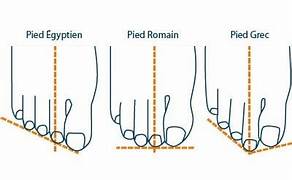 |
This information will help you orient towards the shape of your ideal shoe. From a comfort perspective, a straight shoe will suit a Greek foot better, while an asymmetric shoe will be more suitable for Egyptian and Roman feet.
Two types of shoes share the market. Those with the toe on the big toe, and others centered on the second toe. It goes without saying that you should choose a pair that corresponds to your morphology: Greek, Egyptian, or Roman foot.
This morphological factor will allow you to make a first selection among the proposed models.
Expert product advice:
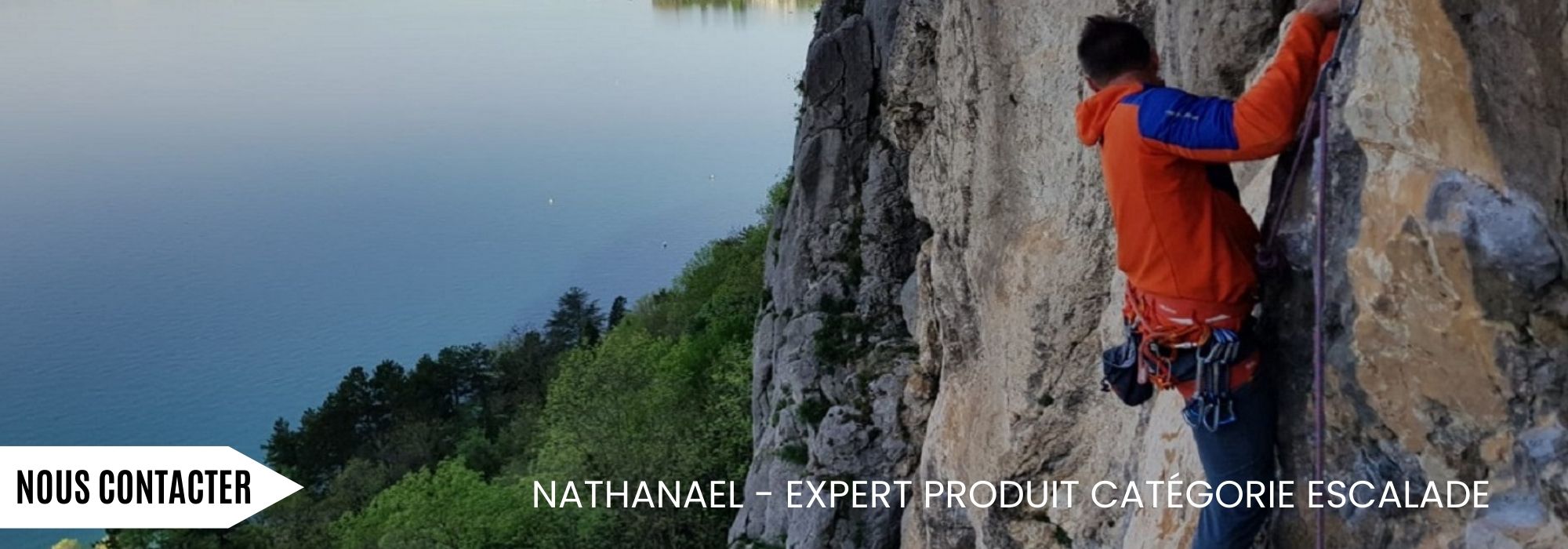
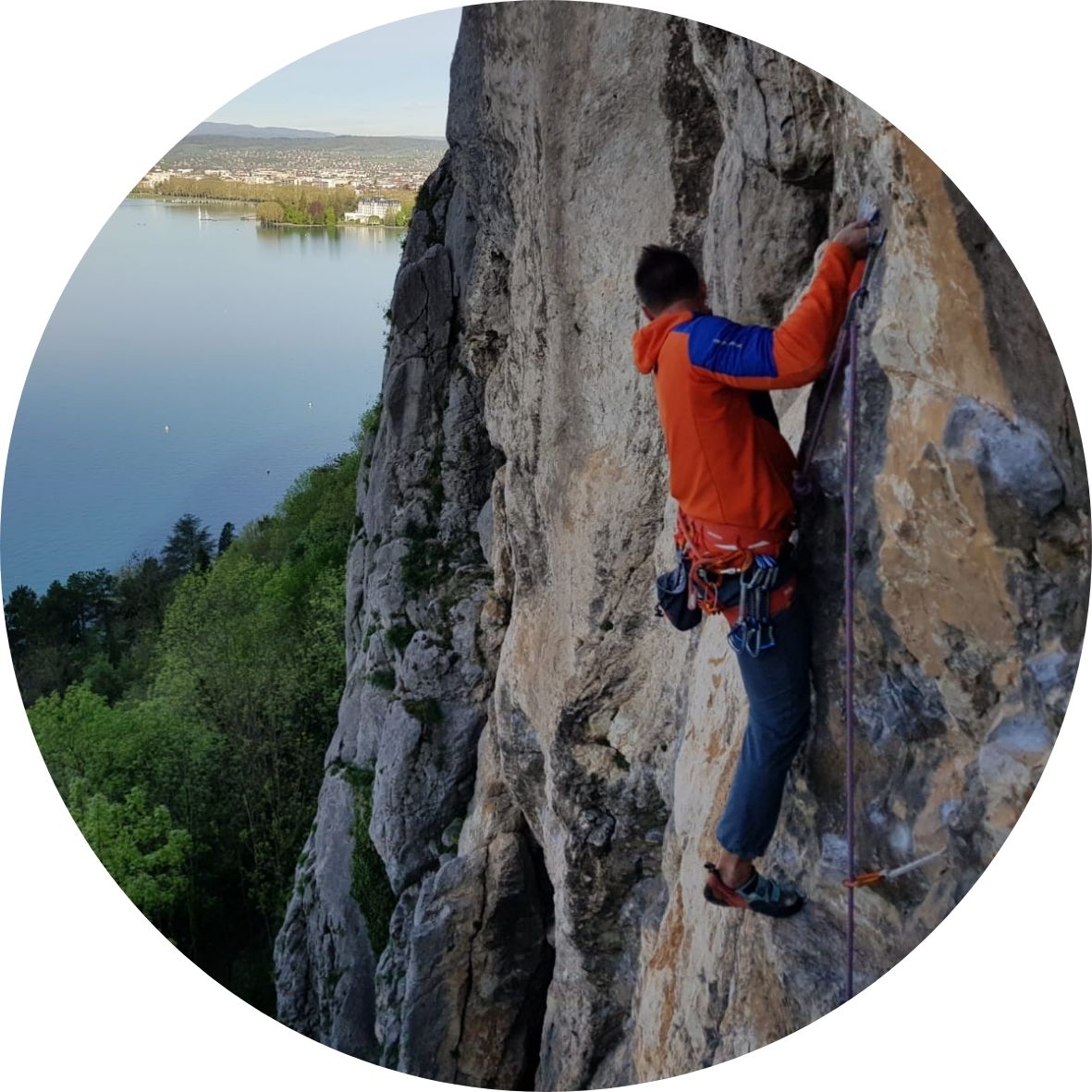 Nathanaël - climbing expert | Choosing your climbing shoe is often difficult... Laces, Velcro, taking one, two, or three sizes smaller? To start, you need to define what your general climbing practice will be: gym, crag, bouldering, etc. Once that is done, you need to know the shape of your foot, that is to say its morphology. Thus, you can orient yourself towards a shoe that is well-fitted but not painful. Your foot should fill the shoe well to exploit precision and climbing strength. |
Choosing your shoe based on your practice?
Depending on the surface you are most often climbing on, it is important to choose the model that is most suited to your practice. Different practices are distinguished in the climbing world: bouldering, crag, multi-pitch, or gym.
For the crag
The most important thing for the crag is to isolate the typical profile on which you climb most regularly. Indeed, for a given grade, the holds will not be the same at all on a vertical wall or on a steep overhang.
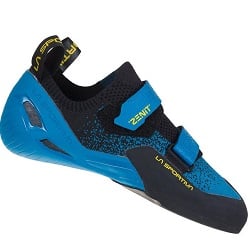
To climb overhanging walls or surfaces with good grip, it is advisable to opt for shoes with a softer sole. Characterized by greater flexibility and sensitivity, they are perfect for ensuring more precise holds, but they are particularly suitable for more experienced climbers whose feet are already accustomed to bearing body weight on a minimal part of it.
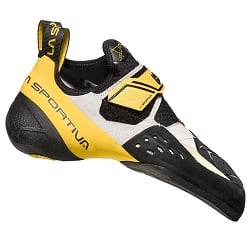
To climb long vertical routes or characterized by small and sharp footholds, we recommend shoes with a stiffer and more comfortable sole, suitable for prolonged use and capable of supporting the climber's weight even on very small holds.
| Overhanging walls or surfaces with good grip | Long vertical routes or with small and sharp footholds |
 |  |
For bouldering
All models can be suitable for bouldering, but it obviously depends on your level and especially the sites and styles you frequent. On a granite site, where the edges are the norm before reaching the final flats, a well-rigid climbing shoe will be strongly recommended, while on sandstone sites, where holds are generally rounder, a softer shoe will allow you to drop lower on your heels and thus gain grip to better conform to the roundness of the sandstone. To learn everything about how to choose your climbing shoes for bouldering or the gym, check out our dedicated guide.
For the gym
For climbing in the gym, having shoes with surgical precision is not necessarily mandatory. However, if you want to occasionally step out of your favorite gym to get some fresh air, then opt for a shoe that offers more versatility and suitability for your outdoor desires.
Choosing your shoe based on your level
It is true that depending on your level, your needs for sensation or your playground vary. The expectations between a beginner and an expert will not be the same.
Here are some recommendations:
For beginners, opt for a shoe with maximum comfort.
To know the ideal size, your foot should not be cramped in the shoe. Prefer a flat or moderately cambered shoe, perfectly suited for good holds on boulders and easy routes. For example, choose the Reflex V climbing shoe from Scarpa or the Tarantula from La Sportiva.
For intermediate levels opt for versatility!
To refine your sensations and perfect your movements, the shoe should be a bit tighter. If discomfort is felt in a shoe that is too constraining for your foot shape, direct your choice towards a more classic shoe that is less pronounced in asymmetry and camber. Note that it is better to have a less technical shoe in the right size than a more technical shoe that is too large. You risk losing precision and power. For example, choose the KUBO climbing shoe from La Sportiva.
For the more experienced opt for more technicality.
In general, the expert climber knows what they want: Velcros or laces, rigid or soft...
Indeed, over time, you will better understand your needs and the sensations sought since you will have learned what kind of climber you are.
Your questions will then be much more focused on the pure technicality of the shoes. You will only need to find your size and know how the shoe moves during use.
Our selection of technical shoes:
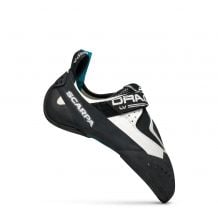
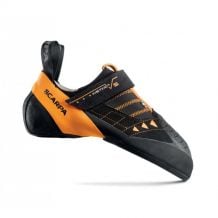
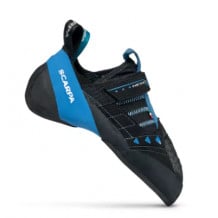
CLIMBING SHOES LA SPORTIVA KATANA LACES
CLIMBING SHOE SCARPA VAPOR
How to be sure of my size?
As small as possible before it hurts too much.
Do not forget that when you try on a pair, your feet swell in the evening or when it is hot. But the only real imperative is that your foot should not float in the shoes. There is no need to go too small either. It should also be noted that not all brands of climbing shoes fit the same way. For some, you will need to take your street size and for others, three or four sizes below that.
It is generally recommended to select a shoe:
- Not too tight, if you choose a shoe with a rigid sole. The rigidity of the sole will ensure optimal support.
- In a smaller and snug fit, in case you choose a shoe with a softer sole, to achieve sufficient foot rigidity.
Remember that a well-fitted shoe does not leave the toes completely extended and fully wraps the foot without leaving any gaps, which leads to a normal sensation of compression, but should not be painful.
 Good to know | There are models specially designed for women on the market that, compared to men's shoes, are generally characterized by a softer structure that allows them to soften under lighter weight. However, it should be noted that the technical solutions used do not exclude the possibility of these products being used by men. |
THE 3 CRITERIA TO REMEMBER:
- The morphology of your foot: the width of the foot's sole is the first element to consider
- Your practice: your choice will vary depending on the type of wall and the more or less intensive use. You will need to orient your choice based on the thickness of the sole, the different degrees of rigidity and flexibility.
- Your level: your climbing level will also guide you. Indeed, it is recommended for a beginner to use stiffer models that will help with practice and evolution.