
 €
€ Hiking
  Camping
  Trail
Trail  Running
  Mountaineering
  Climbing
  Mountain biking
  Road biking
  Survival
  Canyoning
  Alpine Skiing
  Ski touring
  Snow activities
  Snowboarding
  Cross-country skiing
  Lifestyle



Comparison of probes for avalanche safety
Do you want a reliable, lightweight, and easy-to-handle probe when every second counts? We explain everything, without beating around the bush. The avalanche safety probe is not a gadget: it is the tool that allows you to locate a buried victim quickly and accurately. In this comparison, we dissect the flagship models available on the market, their strengths, their limitations, and how to use them in real situations.
At AlpinStore, we choose, test, wear out, and recommend. Each probe listed below has been selected for its robustness in the field, its deployment speed, and the simplicity of locking. The brands present here are PIEPS, ORTOVOX, ARVA, BLACK DIAMOND, CAMP, and MAMMUT: references that our testers know well.
Before diving into the details of the models, a few clear principles: the deployed length must cover the expected depth of burial, the weight must remain compatible with your practice (backcountry skiing, freeride, mountain running), and the locking mechanism must be quick even with gloves. It's as simple as that. We give you concrete advice below.
For a complete outing, remember to pair your probe with an ARVA and a suitable shovel. And if you're looking for other equipment to complete your pack: we also offer quality mountaineering accessories for demanding climbers.
Let's get to the heart of the matter. We first present the six most relevant probes for avalanche safety, with their technical specifications, followed by a summary table for a quick comparison.
The ALU 240 ORTOVOX probe: designed for beginners and for those who want reliability without frills. It uses the quick-lock mechanism for ultra-fast assembly. Basic but effective profile: sturdy, lightweight, and with practical depth markings. Simple and effective. If you want to buy mountaineering equipment to complete your pack, this probe fits perfectly into a well-thought-out safety kit.
The Quickdraw Probe Tour 280 BLACK DIAMOND: this is the intermediate probe designed for those who alternate between groomed slopes and adventure terrain. Longer, it offers better comfort during deep searches. It emphasizes compactness when folded and the precision of centimeter markings. Ideal for outings where you want to maintain a safety margin.
The light 2.40 ARVA: lightweight and compact aluminum, locking by Kevlar cord, diameter 10.2 mm for optimized rigidity. It is tailored for speed of action, for teams that move quickly and need a reliable instrument without weighing down the pack. If you're looking for quality mountaineering gear to complete your setup, this probe remains a very solid option.
The aluminum probe 220 PIEPS: its advantage is the simplicity of deployment and the stability of the tubes, sometimes made of carbon fiber depending on the versions. A bit shorter, it prioritizes speed of action and maneuverability. For quick actions, it holds up well. If you wear a technical outfit for backcountry skiing, this probe stows easily and remains accessible in case of emergency.
The eco cord probe 2.4 m CAMP: 6 segments made of high-grade 6000 aluminum, generous diameter and Dyneema cord with screw lock. Built to last, it plays the robustness card. In the field, it inspires confidence: secure handling, firm locking, and solid mechanical hold, appreciated by climbers who don't want to mess around when it counts.
The probe 240 fast lock MAMMUT space: a balance between lightness and ergonomics. The fast lock mechanism is designed to work even with thick gloves. Its format is designed for those who demand comfort during locking: quick, stable, and precise in positioning.
- Key points to check before buying: deployed length, diameter of segments, type of locking, depth marking, weight.
How to choose according to your practice? If you mainly do backcountry skiing, prioritize a lightweight and quick-to-deploy probe: you will also want a complete and compact backcountry skiing equipment. For committed freeriding, length can be a criterion: a longer probe gives you a margin in case of deep burial.
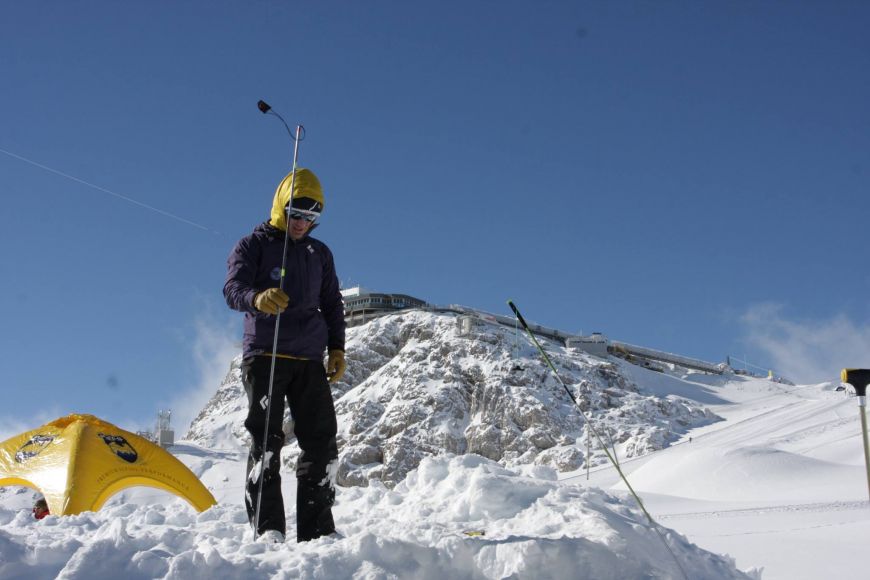
Field usage tips: deploy and lock your probe to train regularly. Muscle memory saves seconds. Organize yourself as a team: clear communication, task distribution, systematic probing method. And review your positioning for probes in case of multiple burials.
- Recommended probing technique: after the ARVA guides you to the nearest centimeter, explore in a grid using the probe markings, plant vertically, read the depth, then mark the area to dig effectively.
To complete your preparation, remember to check the availability of essential items: helmets, shovels, and suitable clothing. If you want to reduce the budget without sacrificing safety, also check our affordable mountaineering clothing that meets technical constraints. And for specific skiing equipment, we offer backcountry skiing helmets online and a targeted selection of technical clothing for backcountry skiing to ensure you are protected and performing.
Why are some probes more expensive? The material, locking system, and precision of markings influence the price. Probes made of carbon fiber or high-end alloys cost more but gain in weight and rigidity. It's all a matter of compromise depending on your practice: weight vs robustness vs price.
A word on maintenance: keep your probe clean, dry it after each wet outing, check the locking points, inspect the cord if present, and replace any damaged elements. A well-maintained probe is a probe that works when it needs to.
The table below summarizes dimensions, weights, and materials. It helps you quickly compare and visualize technical differences.
| probes for avalanche safety | alu 240 ORTOVOX probe | BLACK DIAMOND quickdraw probe tour 280 | light 2.40 ARVA probe | avalanche probe PIEPS aluminum 220 | eco cord probe 2.4 m CAMP | 240 fast lock MAMMUT space probe |
| weight (in grams) | 200 | 342 | 190 | 260 | 263 | 265 |
| deployed length (in cm) | 240 | 280 | 240 | 220 | 240 | 240 |
| material | aluminum | aluminum | aluminum | aluminum | aluminum | aluminum |
| marking or segments | 1 meter marking and lower segment in fluorescent orange | marking every centimeter | marking every 5 centimeters | marking every 5 centimeters | 6 segments | 6 segments |
In conclusion: choose your probe according to your practice and requirements. The models presented cover a wide range of uses: from secured strolls to committed adventure terrain. If you're in doubt, prioritize the simplicity of deployment and effective locking: that's what makes the difference in real situations. And if you want to complete your pack, remember to check our selection of backcountry skiing equipment and quality mountaineering gear for a complete and sustainable preparation.
If you have specific questions about a model, about the probe + shovel + ARVA combination, or you want advice for your type of outing? We are here to help you. We always advise based on the terrain and level: direct, clear, and without bullshit. Prepare your outing intelligently, equip yourself properly, and come back to tell us about your run.
To find the right probe and other essentials, explore our dedicated range: backcountry skiing equipment and everything that ensures a controlled and serene outing.

Leave a Reply
All fields are required