
 €
€ Hiking
  Camping
  Trail
Trail  Running
  Mountaineering
  Climbing
  Mountain biking
  Road biking
  Survival
  Canyoning
  Alpine Skiing
  Ski touring
  Snow activities
  Snowboarding
  Cross-country skiing
  Lifestyle





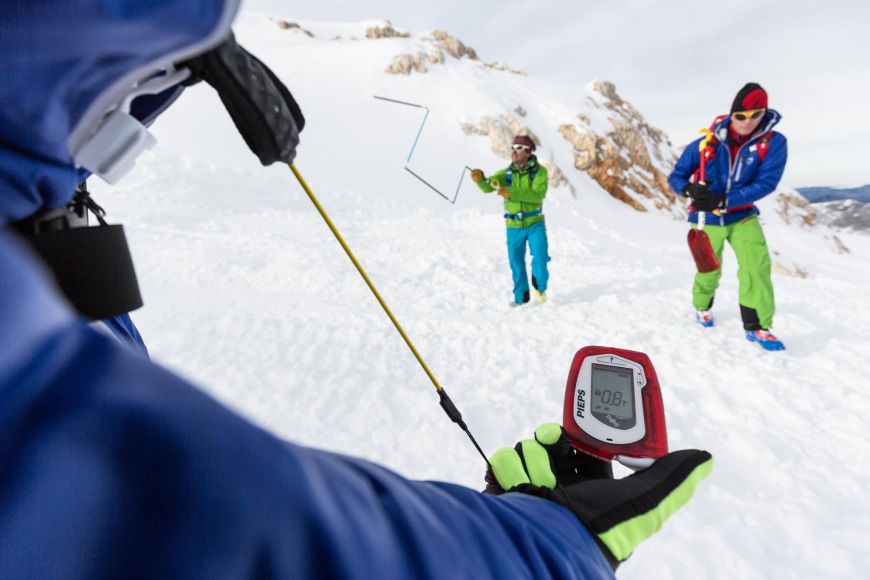
Avalanche victim detector: comparison and guide for pros
Are you preparing for a challenging outing or equipping a team of guides? The choice of an avalanche victim detector is not trivial. Here we talk real: functions, ergonomics, range, search speed, and reliability in real conditions. We compare devices suitable for quick interventions and technical outings, so you can find your victim quickly and without hesitation.
At ALPINSTORE, we test in the field. We have put the devices against real scenarios: multiple missions, crossed signals, multiple victims. The goal: to give you a clear view to choose the right tool according to your professional use, whether you are a guide, rescue worker, or team leader in high mountains.
An effective avalanche victim detector must meet three requirements: long-range detection, precise final phase search, and intuitive interface to save seconds. No unnecessary gadgets. Useful functions: marking mode, multi-mission management, automatic switching between transmit/search, and clear directional indications.
Why does range matter? The greater it is, the more you can locate a victim during an extensive avalanche, and the more you can prioritize your search area. But range means nothing without search bandwidth and filtering algorithms to eliminate interference signals.
In maintenance and preparation, also think about your bag and your organization: knowing where to place the device, the shovel, and the probe. We often give practical advice for
You also want to equip your mountaineering kit: you need to know how to combine detection and passive safety. To store your device and access your tools quickly, you should think about choosing a climbing and mountaineering bag above all, so that everything is accessible in an emergency situation.
The devices tested here come from a handful of proven references in the professional field. They stand out for their ergonomics, robustness, and clarity of indications in search. When intervening under pressure, you want a readable screen, simple controls, and maximum battery availability.
And for technical interventions, the equipment doesn't stop at the detector: it is complemented by safety tools and mountaineering ice axes, ropes, and screws if necessary. A controlled intervention starts with reliable and suitable equipment.
Here is a summary table to quickly compare the main characteristics: number of antennas, maximum range, search bandwidth, battery life, and weight. This data helps you decide based on your user profile.
| detector | dva ortovox 3+ | dva pieps dsp pro | arva axio | dva barryvox s mammut | dva pieps micro |
| number of antennas | 3 | 3 | 3 | 3 | 3 |
| maximum range (m) | 40 m | 60 m | 80 m | 95 m | 50 m |
| search bandwidth (m) | 55 m | 60 m | 70 m | 50 m | |
| battery | 1 AA alkaline 1.5 V | 3 AAA alkaline batteries, IEC-LR03, 1.5 V | 3 AAA/LR03 alkaline batteries | 3 x AAA 1.5 V alkaline battery | 1 AA alkaline battery |
| transmission autonomy (h) | 250 h | 400 h | 250 h | about 300 h | 200 h |
| dimensions (mm) | 122 x 73 x 27 | 115 x 74 x 27 | 112 x 75 x 30 | 115 x 67 x 27 | 106 x 74 x 20 |
| weight (g) | 210 g | 200 g (batteries included) | 230 g | 205 g | 150 g (batteries included) |
| warranty (years) | 5 | 2 years extendable to 5 years | 2 years + 3 years if registered | 2 years base + possible extension | 2 years extendable to 5 years |
You see the differences: some models prioritize raw range, others ease of use and weight savings. For professional use, we favor ergonomics in multi-victim searches and stability of parameters. We explain how to turn these numbers into purchasing decisions.
Quick practical tips:
- train regularly: timed searches, marking, and recombinations;
- check the batteries before each outing and keep spares;
- prefer a device with marking function if you work in a team;
- do exercises in varied conditions: multiple signals, interferences;
- combine the detector with a quality shovel and probe and an intervention plan.
Beyond the detector, your safety also depends on the rest of your equipment. If you want to complete your pro pack, consider investing in ice screw equipment suitable for anchors or quick anchors and, depending on the route lines, a high-performance mountaineering equipment that withstands repetition and extreme conditions.
With us, we often advise not to sacrifice quality on critical elements: quality mountaineering ropes allow for smooth and secure maneuvers, ice axes should be chosen based on the ice and slope, and the entire set must be maintained. We also guide you to buy reliable and tested mountaineering equipment.
Are you hesitating between lightness and versatility? For competitions or fast races, a lightweight model like some micro DVA can make the difference. For long interventions or rescue teams, prioritize robustness and autonomy. These choices influence your capacity for action and the safety of the team.
Finally, remember that the detector is a search tool, not total insurance. Prevention remains paramount: reading the snowpack, group management, decision-making. Combine the use of the detector with training and regular exercises to stay effective.
Do you want personalized advice? ALPINSTORE is a team of enthusiasts who test in the field. We offer you quality mountaineering equipment and user reviews from professionals. We help you choose a coherent pack: detector, shovel, probe, ice axes, and protections adapted to your action terrain.
In conclusion: choose your detector based on your professional use, train, keep your equipment in good condition, and always complement with good material. A well-prepared intervention often means a life saved. We advise you straightforwardly, like friends on a rope team. Ready to equip your team?

Leave a Reply
All fields are required