€
€ Hiking
  Camping
  Trail
Trail  Running
  Mountaineering
  Climbing
  Mountain biking
  Road biking
  Survival
  Canyoning
  Alpine Skiing
  Ski touring
  Snow activities
  Snowboarding
  Cross-country skiing
  Lifestyle





ALL ABOUT SNOWBOARDING
THE CONSTRUCTION OF THE SNOWBOARD
- Nose: the nose corresponds to the front of the snowboard, that is to say from the top of your snowboard to your binding. For in-depth advice, consider buying a quality snowboard from a specialist.
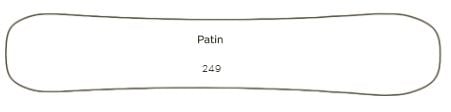
- Waist: the waist corresponds to the width of the board between your feet. To help you know it, you will find the diagram below on each product sheet on Alpinstore.
- Tail: the tail corresponds to the back of the snowboard, that is to say from your back foot to the end of the board.
- Edges: located on either side of the base, they allow you to link turns.
- Frontside edge: for turns where you look up the slope
- Backside edge: for turns where you look down the slope
- Base: the bottom part of the snowboard, which is in contact with the snow. This allows you to glide and go faster or slower
- Inserts: the inserts are the insertion points on the board, which allow you to screw in different types of bindings
- Camber: there are several types of camber, each adapted depending on the desired practice.
- Traditional camber
- There is a contact point at the front (nose) and at the back (tail) of the board. The waist (between the feet) is elevated
- This camber provides excellent sensations
- It ensures responsiveness and stability
- Reverse camber
- The lowest point of the board is in the center since both ends are raised
- With this camber, edge faults are less frequent
- The board is forgiving and playful underfoot
- Turns are easy to initiate
- Ideal camber for freestyle and can be found on beginner boards
- Flat camber
- The board is completely flat, from nose to tail
- This camber allows for better grip, better responsiveness, and better stability
- It is ideal for all mountain
- Gullwing camber (W)
- With this camber, you will have 3 rocker zones (nose/waist/tail), making the board playful, forgiving, and buoyant in powder
- It allows for excellent responsiveness
- Camber + rocker
- The board features two rockers: one in the nose (front) and one in the tail (back)
- The camber is traditional between the inserts
- This model ensures stability and responsiveness
- Ideal for freeride and all mountain
- Traditional camber
- Shape: there are several shapes of snowboards that are also adapted depending on the practice.
- Twin shape
- This is 100% symmetrical, allowing you to ride switch as well as regular (forward and backward)
- The most well-known shape in freestyle
- Directional twin shape
- This is symmetrical but the inserts are slightly offset towards the back of the board, to provide more performance on hard and fresh snow
- Ideal shape for all mountain
- Directional shape
- This presents with the inserts offset to the back for a longer nose (front) and thus better buoyancy in fresh snow
- This shape still allows for excellent grip on groomed slopes
- Ideal shape for freeride and for the slope as it provides stability at high speeds
- Twin shape
Find all our snowboards and all our snowboard packs on Alpinstore. Also discover our complete snowboard equipment for a worry-free trip!
THE DIFFERENT SNOWBOARDING PRACTICES
- Slope: snowboarding on slopes is defined by descents on marked and groomed trails. This practice, which is accessible to all, can be practiced by children as well as adults, from beginners to experts. To please the largest number and meet all levels, there are four colors of slopes: green/blue/red/black (from easiest to hardest). Here, the snowboarder will make turns on the same type of snow. If you want to equip yourself, the snowboard adapted to slope practice is essential.
- All mountain: All mountain snowboarding is defined by descents on all types of terrain, whether on groomed slopes, the edge of the slope, and off-piste. This practice also takes into account all types of snow, that is to say, smooth, crusty, bumpy, or fresh, it is accessible from the intermediate level since it requires a minimum of technique. Here, the snowboarder will therefore make turns on both groomed and ungroomed slopes.
- Freeride: Freeride snowboarding is defined by descents on terrains where the snow is not groomed and often, where there are no tracks. This practice, which is accessible for advanced to expert levels, requires physical effort as well as technique. Since off-piste is not secured, it is important to have knowledge or to know the environment perfectly as well as the safety rules. Here, the trajectories are free.
- Freestyle: Freestyle snowboarding is defined by the execution of jumps and tricks whether in snowparks or off-piste (backcountry). This acrobatic practice is like all other disciplines, accessible for all ages, and requires quality snowboard accessories adapted to safety and performance. Here, the snowboarder performs jumps/modules and will do slides/ramps.
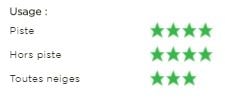
To help you understand the practices of each snowboard, you will find the diagram below on each product sheet on Alpinstore:
THE DIFFERENT LEVELS OF SNOWBOARDERS
- Beginner: a beginner snowboarder is a person who has never practiced snowboarding or has done it very few times. This person will therefore make edge faults even if the practice is only on groomed slopes and a gentle slope.
- Intermediate: the intermediate snowboarder is a person who is beginning to understand variations in speed and slope, who still lacks confidence. In this case, the snowboarder feels the pleasure of gliding which is mainly on groomed slopes. They present with a technical base since they are capable of moving and being autonomous on gentle slopes.
- Advanced: the advanced snowboarder is a person comfortable with their equipment, who controls their board and trajectories as well as their speed. They are rather comfortable on all terrains, whether the snow is groomed or not. They make few edge faults and will gain speed without hesitation.
- Expert: the expert snowboarder is a person with a technical level that allows them to find pleasure in all situations. They can go anywhere and do not make edge faults. Curious about the different types of equipment and different settings, this snowboarder will try several cambers and/or several shapes to find their happiness. Take the opportunity to explore our cheap snowboard clothing collection to complete your equipment.
YOUR SNOWBOARD IS SELECTED BASED ON FOUR MAIN CRITERIA
Note, it is important to note that your morphology is essential in choosing the size of your snowboard. If you are for example, short and stocky / tall and thin / other atypical morphologies, you will need to adapt the size of your board. The information below is for guidance only.
YOUR PRACTICE
- Slope: to be an excellent snowboarder on slopes, you need suitable equipment. Ideally, your snowboard should meet the following criteria:
- Excellent grip
- Not too wide to maintain good maneuverability but be careful of toes that stick out! Your shoe size is decisive in choosing the width of the board
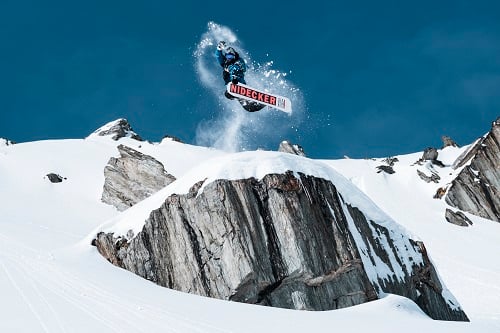
- In this product range, you will find our Nidecker snowboards
- All mountain: To enjoy all types of snow, your snowboard must have:
- Versatility to be able to go both right and left, on groomed and ungroomed slopes
- It should be moderately long: You need to find the right balance between grip, maneuverability, and buoyancy
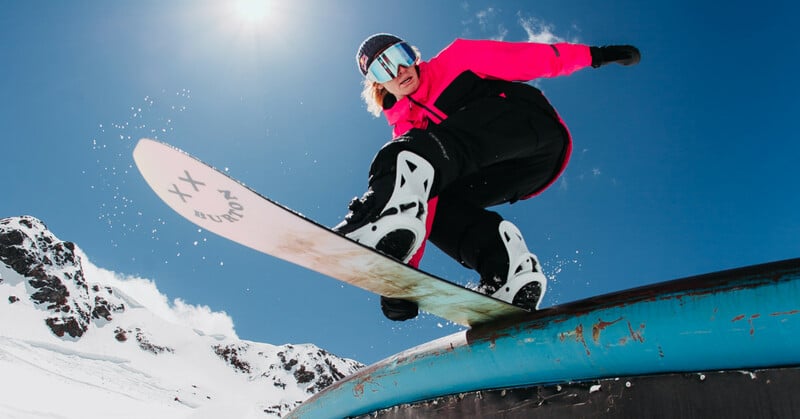
- In this product range, you will find our Burton snowboards and also our Burton boots at the best price to complete your outfit.
- Freeride: a freeride snowboard must perfectly suit this crazy and committed practice. Ideally, it should have:
- Stiffness for incredible responsiveness
- A longer length for better stability
- A directional + rocker profile for better floatation in powder
- Note that freeride boards are often very high-performing
- In this product range, you will find our Nitro snowboards, our Jones snowboards, and consider the THE ONE SEASON Ortovox collection for optimal equipment on fresh snow!
- Freestyle: to perform jumps and send yourself into the air, you need a snowboard adapted to this practice and it should:
- Have a twin-tip profile (symmetrical) to be able to ride in both directions
- Be slightly shorter for more maneuverability and playfulness
- Be responsive, thus +/- stiff
- In this product range, you will find our Rossignol snowboards
YOUR LEVEL
- Snowboard for a beginner level: a beginner will lean towards a board that allows them to evolve and link turns on groomed snow. For this, a soft snowboard is needed for incredible maneuverability and to avoid too much physical effort. It should also be stable with a slight camber or a flat camber.
- Snowboard for an intermediate/advanced level: the board for this level should ideally be as progressive as possible to accompany you everywhere, regardless of the conditions. It should allow for good control and excellent grip.
- Snowboard for an expert level: a person of excellent level should select their board based on their practice and ideally, should lean towards a precise, responsive board that ensures stability at high speeds.
YOUR SIZE : Note, this information is for guidance only!
As you may have understood, the choice of the size of your snowboard depends on the practice but also on your level. To make it easier for you, Alpinstore offers this table, which presents the ideal size of your snowboard, based on the two main criteria. To help you, Alpinstore offers you a size guide, go take a look! Don’t forget to protect your equipment with the quality snowboard covers offered in our catalog!
| Beginner | Intermediate | Advanced | Expert |
All mountain (slope/off-piste) | 20 to 25cm shorter | 20 to 25cm shorter | 15 to 20cm shorter | 15 to 20cm shorter |
Freeride | 15 to 20cm shorter | 15 to 20cm shorter | 10 to 20cm shorter | 10 to 20cm shorter |
Freestyle | 20 to 25cm shorter | 20 to 25cm shorter | 15 to 20cm shorter | 15 to 20cm shorter |
YOUR SHOE SIZE
Today, the world of snowboarding has evolved a lot and offers you models adapted to your morphology, particularly in terms of board width. It is essential to choose a board adapted to your shoe size. Here are some tips to help you:
- From 250 to 255mm: for standard feet (41 to 43.5)
- 255 to 260cm: mid wide (44 to 45)
- >260cm: wide (45+)
On Alpinstore, you will find wider boards (called Wide) in the size dropdown and/or in the product reference, present under the product sheet title. Indeed, when a board is “wide”, there is a “W” that appears. Additionally, discover our new ready-to-ride snowboard packs for all levels.
TO SUM UP
You will have understood, the practice of snowboarding is complex as it takes into account many criteria. To correctly choose the snowboard that will suit you perfectly, here are the four criteria to consider:
- Define your practice (slope, all mountain, freeride, freestyle) to be able to orient yourself towards an adapted snowboard range. As we explained above, boards are different depending on their activity.
- Once your practice is defined, it is important to assess your level. This will guide you towards models consistent with either a greater stiffness for maximum dynamism, or a softer board that will require less effort and technique to turn.
- It is then time to choose the ideal size of your snowboard to enjoy yourself throughout the winter. As explained several times, this will depend on your practice, your level, and not forgetting your build. Your shoe size is therefore essential!