€
€ Hiking
  Camping
  Trail
Trail  Running
  Mountaineering
  Climbing
  Mountain biking
  Road biking
  Survival
  Canyoning
  Alpine Skiing
  Ski touring
  Snow activities
  Snowboarding
  Cross-country skiing
  Lifestyle






Hiking is a sports discipline that combines walking and nature. This activity allows you to exercise while enjoying different landscapes. To fully enjoy your ascent in the mountains, it is essential to choose poles that are suitable for your practice, your height, etc. This accessory will help you tackle both descents and ascents during your outings. They will improve your stability and endurance, regardless of the terrain. Today, finding perfectly suitable poles has become complex. There are a large number of products on the market, as well as other essential elements for hiking equipment. That is why we provide you with tips for choosing them well.
What are the advantages of using walking poles?
Hiking poles are a classic but essential piece of equipment for proper hiking practice. Often sold in pairs, they will help improve your stability and significantly relieve your knees. There are adjustable or non-adjustable poles in length, or poles with springs to absorb shocks even more. Using poles has many advantages: it will ensure better performance and relieve your joints.
Technical advantages:
Thanks to hiking poles, your ground support is doubled. You will therefore have four points of contact, which complements a good backpack for carrying; discover our affordable hiking backpacks. This will provide you with good balance and optimal stability. The risk of falling and injury is therefore much lower.
Physical advantages:
Hiking poles will significantly relieve your body, as the pressure exerted on your lower limbs is reduced. This accessory ensures that your hiking outings are much less traumatic for your joints and will limit your joint pain. They will allow for good weight distribution and thus relieve you both uphill and downhill. Poles provide you with high comfort during your mountain outings.
Moreover, poles help with your physical performance. You can increase your walking pace without tiring yourself more. You are therefore more efficient and achieve better performance while reducing your muscle fatigue. Also, consider choosing high-performance hiking shoes to complete your equipment.
After this point on the advantages of using hiking poles during your hikes, we will look at the technical characteristics so that you can later choose poles perfectly suited to your needs. For an optimal set, it may also be interesting to look at our selection of complete hiking gear.
EXPERT PRODUCT ADVICE:
 | During a hike, adjusting the size of your poles is very important. This will allow you to be more comfortable and ensure your support. When you start the ascent, you should slightly shorten the poles. Conversely, when you tackle the descent, it is advisable to lengthen them. Malaurie - Product expert for the hiking/trekking universe About Malaurie "A great enthusiast of all kinds of sports, I lead a life at two hundred miles an hour where weekends rhyme with outdoor activity" |
How many sections on a hiking pole?
The number of sections corresponds to the number of parts of the pole. There are two types of poles: mono-section and multi-section. Each responds to different characteristics.
The mono-section will have the particularity of being lighter and will resist less over the long term, as they are made from a single block and therefore have no tension zone.
In contrast, multi-section hiking poles have the characteristic of retracting or folding according to the technologies used. The main advantage of this accessory is that it can be attached to your backpack when you no longer need it. They reduce in size by 2 to 4 times once folded. For many hikers, it is important to be able to store their poles without any bulk, next to your high-top hiking shoes and other essentials.
What are the different locking and adjustment systems?
There are 3 different adjustment and locking systems for multi-section hiking poles:
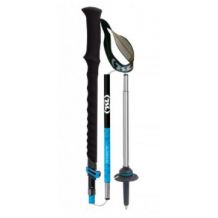
First, there is the screw lock found on telescopic poles. This system allows you to adjust the height of your pole from one section to another. Once you have found the size that suits you, you just need to secure your adjustments with the screws at the tightening points. However, this type of pole is more suitable for occasional hiking and on accessible terrains. Indeed, it is possible that they may become misadjusted over the course of your outings.
Secondly, there is the clip tightening, this system is more suitable for regular and intensive hiking practice. Indeed, it is very simple and quick to modify the size adjustments or to fold them for storage thanks to locking clips. They are highly recommended for routes where support is very important.
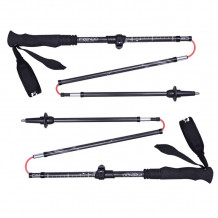
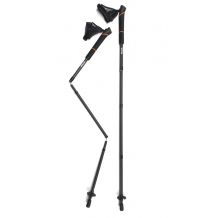
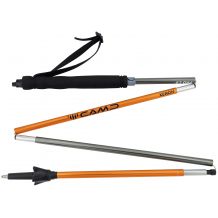
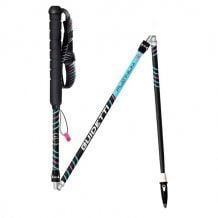
Finally, there is the Z-folding system, this system is present on three-section poles. The different sections are connected by a wire that runs through the entire tube. To lock or unlock, you just need to use the small push-button located on the handle. This type of pole is highly recommended for hikers looking for lightweight equipment with very quick setup, especially in combination with low hiking shoes for versatility.
How to choose the right size for your hiking poles?
It is essential to choose the right size for your hiking poles. If they are not perfectly suited to you, the benefits will not be optimal.
First, for mono-section or non-adjustable Z poles, it is important to choose the right size to benefit from the advantages. To know your perfect size, simply multiply your height in centimeters by 0.68.
Additionally, size guides are often available to help you find the perfect pair.
As for telescopic poles, they can adjust in height by about 20cm. This allows you to be comfortable on changing terrains.
DID YOU KNOW?
 | If you choose poles with a single shaft, and you do not have a way to calculate the ideal size. You just need to stand up straight, take the poles in hand, and see if your elbow forms a right angle with your forearm. Depending on the result obtained, you will simply need to take a size up or down and repeat the same technique until you find one that suits you perfectly. |
What are the different materials of hiking poles?
Materials:
First, we have aluminum poles. Weight is one of the main differences with carbon. Indeed, they are slightly heavier, about 500 to 600 grams per pair. Additionally, aluminum is a material that absorbs shocks, vibrations, etc., less effectively. But the great advantage of this material is that it is very robust and difficult to bend.
Next, there are carbon poles, which are much lighter. A pair weighs about 350 to 500 grams. In addition to this advantage, carbon absorbs shocks and reduces vibrations. However, this material is much more fragile, so the pole is less resistant. It is important to take this into account when going on technical hikes or if the distance is high.
Tips and tips:
There are two types of elements that come into direct contact with the ground: tips and tips. These are parts of the pole that should not be neglected. Indeed, they will allow you to grip the ground better.
Two types of tips are available on the market: steel and carbon. Steel tips are more suitable for occasional hikers, as they are less durable over time.
In contrast, for more intense use, carbon tips are recommended. Indeed, they are more technical and provide optimal grip and resist better over time.
As for the tips, they are made of rubber and are applied directly to the tips. This accessory has two uses: first, it prevents you from damaging your clothes when the poles are stored in your backpack, or it will limit the risk of injury. If you are looking to complete your gear, consider exploring our category hiking pole accessories.
Tips are mandatory on certain trails, as the tips could severely damage biodiversity. Additionally, they also provide excellent comfort when hiking on hard terrains.
Handles:
There are three categories of handles. These elements are very important, as they provide you with good grip and different comfort.
First, there are foam handles, which are very comfortable because they are particularly soft to the touch and absorb sweat. You keep your hands dry throughout your hike. However, foam is slightly less durable. This type of handle is recommended for long-distance outings.
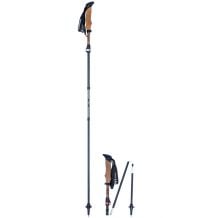
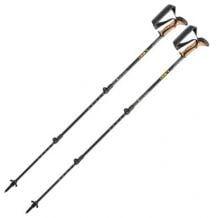
The second type of handles is those made of cork. This material has excellent moisture evacuation. This handle has the advantage of perfectly adapting to the shape of your hands for optimal comfort. Finally, cork is a material that absorbs vibrations.
Lastly, there are rubber handles, which are very insulating from the cold, and rubber absorbs vibrations and shocks significantly. However, these handles do not regulate moisture, so in summer, your hands are more likely to slip, and they will wear out more quickly. It is therefore advisable to opt for these handles in winter.
TO REMEMBER:
- CHOOSE THE NUMBER OF SECTIONS BASED ON YOUR HIKING PRACTICES
- DO NOT TAKE UP TOO MUCH SPACE
- CHOOSE THE RIGHT SIZE FOR MORE COMFORT AND PERFORMANCE
- USE HANDLES SUITED TO YOUR OUTINGS