€
€ Hiking
  Camping
  Trail
Trail  Running
  Mountaineering
  Climbing
  Mountain biking
  Road biking
  Survival
  Canyoning
  Alpine Skiing
  Ski touring
  Snow activities
  Snowboarding
  Cross-country skiing
  Lifestyle



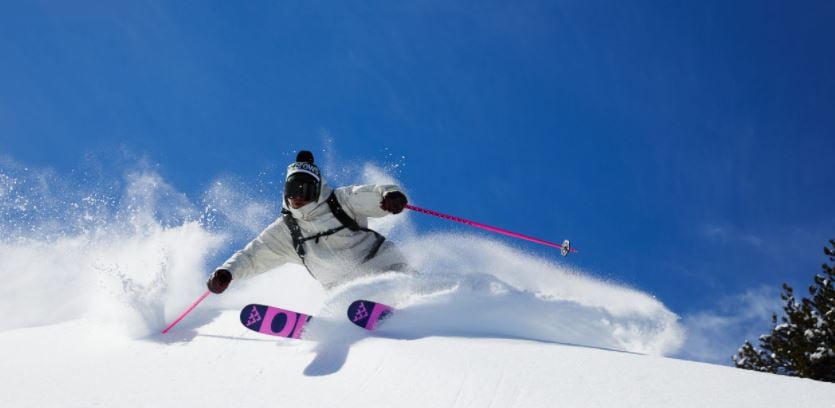
ALL ABOUT ALPINE SKIING
Find all our best alpine skis on the site alpinstore.com. Discover also our dedicated page for buying alpine skis suitable for all styles and levels.
THE CONSTRUCTION OF ALPINE SKIS
- The tail : this is the lower part of the ski, located at the back of the binding. It is shaped differently depending on your practice. For groomed runs, the tail is straight, and the closer you get to freeride, the more the tail is raised for better maneuverability.
- The waist : represents the width of the ski at the level of your arch. The narrower the waist, the better the maneuverability. On groomed runs, the waist is rather thin, but the closer you get to freeride, the wider the waist for excellent stability and floatation.
- The tip : this is the upper part of the ski, located at the front of the binding. It varies depending on the discipline as it can be wider or longer. Indeed, for groomed runs, the tip is moderately wide and not very raised, but the closer you get to freeride, the wider and more raised the tip is for better maneuverability and stability.
On the site Alpinstore, you will find the graph below for each pair of skis, showing the three main dimensions. This will help you select your pair of skis based on your practice:

- The edges : represent the gray/metallic part on each side of your ski. They allow you to make turns and carve. The more your ski is inclined on your edge, the faster you will turn. In the long term, they require regular sharpening to maintain this grip.
- The base : this is the part (often black) of your ski that is in contact with the snow. It allows you to glide and thus descend the slopes. The more your ski is flat, the faster you will go.
- The radius: it is the radius of the circle that a ski can make on its edges. The larger the radius, the longer the turns you will make, and the smaller the radius, the more capable you will be of making short turns. This characterizes the behavior of your ski in tight turns and is often noted on the back of your ski, near the tail.
THE DIFFERENT PRACTICES OF ALPINE SKIING
- Groomed skiing: Groomed skiing is defined by descents on marked and groomed slopes. This practice, which is accessible to everyone, can indeed be practiced by children as well as adults, from beginners to experts. To please the largest number and meet all levels, there are four colors of slopes: green/blue/red/black (from easiest to hardest).
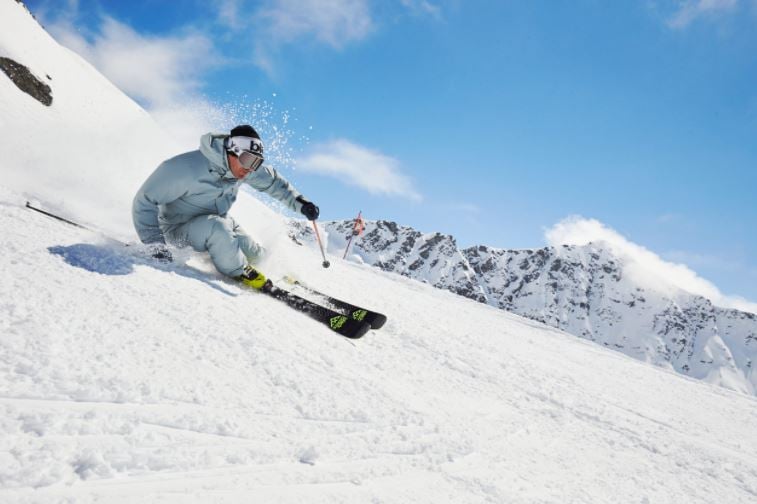
- All mountain skiing: All mountain skiing is defined by descents on all types of terrain, whether on groomed slopes, the edge of the slope, or off-piste. This practice also takes into account all types of snow, meaning smooth, crusty, bumpy, or fresh, and is accessible from the intermediate level as it requires a minimum of technique.
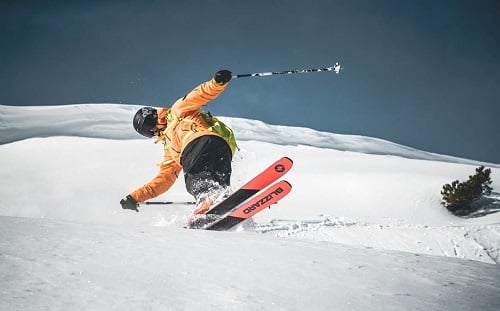
- Freeride skiing: Freeride skiing is defined by descents on terrain where the snow is not groomed and often where there are no tracks. This practice, which is accessible for advanced to expert levels, requires physical effort as well as technique. Since off-piste is not secured, it is important to have knowledge or to be well acquainted with the environment and safety rules.
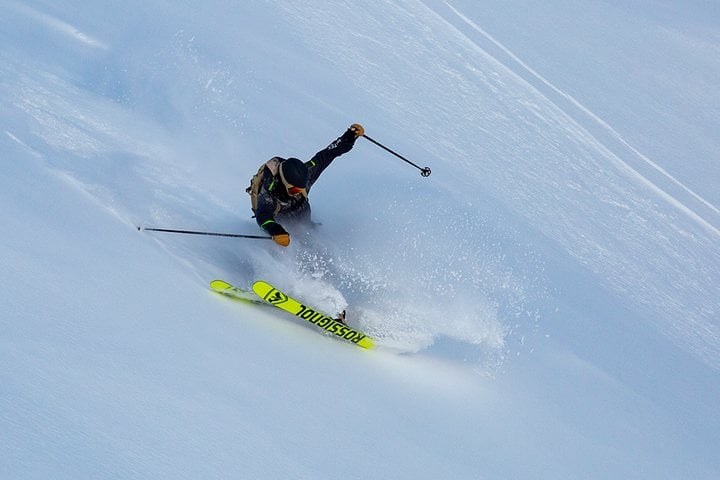
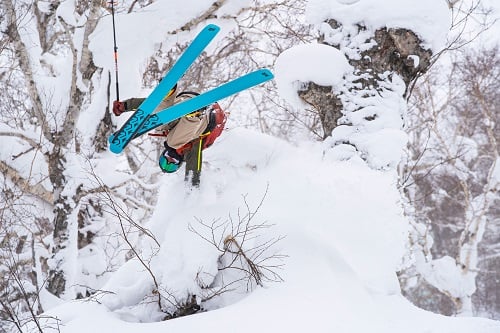
- Freestyle skiing: Freestyle skiing is defined by the execution of jumps and tricks, whether in snowparks or off-piste (backcountry). This acrobatic practice of skiing is, like all other disciplines, accessible to all ages.
THE DIFFERENT LEVELS OF SKIERS
- Beginner : a beginner skier is a person who has never skied or has done so very few times. This person will therefore make turns in a snowplow at low speed and then in a skid. The terrain is obviously groomed and the difficulty of the slope is low (green and blue slopes).
- Intermediate : an intermediate skier is a person who is beginning to handle variations in speed and slope, who still lacks coordination in their movements but who skis parallel on groomed slopes. They start to seek out terrain features and new situations. The slopes an intermediate skier uses are: green, blue, and red.
- Advanced : an advanced skier is a person who is comfortable with their equipment, who controls their skis, masters their trajectory, speed, and direction changes. This skier seeks to move away from the classic flow by skiing on varied snow and steeper slopes. They are capable of skiing all slopes such as green, blue, red, and black.
- Expert : an expert skier is a person who has a technical level that allows them to find pleasure in all situations (on and off-piste). With good physical qualities, this skier performs well on all different types of snow and terrain.
YOUR PAIR OF SKIS IS SELECTED BASED ON THREE MAIN CRITERIA
YOUR PRACTICE
Groomed skis: To be an excellent skier on groomed slopes, your equipment must be suitable. Therefore, your pair of groomed skis must meet the following criteria :
- A classic camber (ski/snow contact at the tip and tail)
- A narrow waist (generally less than 85mm) for good skiability
- A radius suited to your desires (low for short turns / high for longer turns)
- Excellent grip as the "edge to edge" transition is systematic
- Good maneuverability to perform all types of turns
Here, Alpinstore offers you a wide selection of skis with the brands Rossignol and Dynastar as well as several groomed ski packs with bindings fully equipped.
All mountain skis: To enjoy all types of snow, your pair of skis must present with :
- A classic camber with a front rocker (slightly raised tip) to facilitate turns on ungroomed snow
- A width +/- wide for good skiability/floatation in powder. The wider the ski, the more pleasant it will be to handle in fresh snow, but the harder it will be to pivot on groomed slopes (curve harder to hold and less grip).
- Versatility to be able to take you anywhere, regardless of the terrain
Here, Alpinstore offers you a wide selection of skis with the brands Blizzard, Fischer, K2, Volkl and Zag. Take advantage of our all mountain ski pack offers ready to ski for a simple departure.
Freeride skis: A freeride ski must be perfectly suited to this crazy and committed practice. For this, your pair of skis must have :
- A classic rocker front/back OR a flat camber with front/back rocker OR an inverted camber
- A wide waist (generally greater than 110mm) for perfect skiability in powder.
- A significant length to be able to gain speed while remaining stable and to ensure excellent floatation in fresh snow
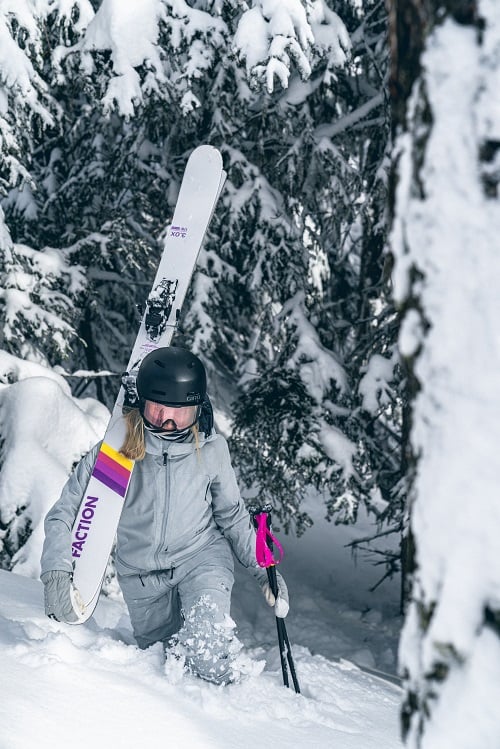
Here, Alpinstore offers you a wide selection of skis with the brands Black Crows and Faction, as well as a selection of freeride ski packs with bindings.
Freestyle skis: To perform jumps and send it in the air, you need a pair of skis adapted to this practice, and they must :
- Be twin-tipped for good switch riding (backwards) OR have a classic camber with front/back rocker
- Have a narrower width for parks / wider for backcountry
- Be a little shorter (in size) than for other practices
Here, Alpinstore offers you some freestyle ski models, in the majority of its alpine ski brands.
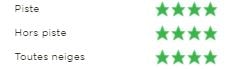
On the site Alpinstore, you will find the illustration below to help you understand the uses suited to each pair of skis. Thanks to these stars, you can orient yourself towards the ski you need, based on your practice and desires. For optimal equipment, also explore our complete ski equipment for the mountain.
YOUR LEVEL
- Skis for a beginner skier : A beginner will initially orient themselves towards a groomed ski to be able to evolve and link turns on groomed snow. It should be soft to handle easily, without too much physical effort. To have fun and keep good memories of groomed skiing, the ideal is to wear a "short" ski, meaning smaller than your height, for excellent skiability.
- Skis for an intermediate skier : An intermediate level skier should equip themselves with a pair of skis that allows them to go a little faster and better control their trajectories. Therefore, a soft ski is always needed for easier handling, short for good skiability, and a little more responsive to be able to tackle steeper slopes.
- Skis for an advanced skier : An advanced level skier must choose their pair of skis based on their practice (groomed, all mountain, freeride, freestyle) since the constructions and shapes are different. The waist of the ski should be at least 80mm to 100mm for all mountain practice. Here, it is important for the skier to select a dynamic pair of skis to obtain responsiveness underfoot on varied terrain.
- Skis for an expert skier : An expert skier must also select their pair of skis based on their practice and ideally should orient themselves towards a waist width of at least 95mm to enjoy powder. The ski must obviously be as responsive as possible to be able to evolve on different terrains and different types of snow.
YOUR SIZE
As you may have understood, the choice of the size of your ski depends on the practice but also on your level. To make your choice easier, Alpinstore offers you this table, which presents the ideal size of your pair of skis, based on the two main criteria. For the whole family, also find your pairs of ski boots for adults and children as well as Fischer ski boots for perfect support and optimal comfort.
| Beginner | Intermediate | Advanced | Expert |
Groomed | 10 to 15cm shorter | 10cm shorter | Your height minus 5cm | Your height minus 5cm |
All mountain | - | 5 to 10cm shorter | Your height minus 5cm | Your height or more |
Freeride | - | - | 5 to 10cm longer | 5 to 15cm longer |
Freestyle | - | - | Your height minus 5cm | Your height minus 5cm |
On the site Alpinstore, in the size guide for your skis (on each ski product sheet) you will find the illustration below to give you an idea of the ideal size you need, based on your level:

TO SUM UP
You will have understood, the practice of skiing is complex as it takes into account many criteria. To correctly choose the pair of skis that will suit you wonderfully, here are the three things to define precisely :
- Define your practice (groomed, all mountain, freeride, freestyle) to be able to orient yourself towards an adapted range of skis. Since, as we explained above, skis are different depending on their activity. To help you, feel free to consult our article dedicated to choosing your alpine skis according to your goals.
- Once your practice is defined, it is important to assess your level. This will help orient you towards coherent models with either a greater rigidity for maximum dynamism or a softer ski that will require less effort and technique to pivot.
- It is then time to choose the ideal size of your pair of skis to enjoy yourself throughout the winter. As explained several times, this will depend on your practice, your level, and your build.
To complete your outfit, take advantage of our Black Diamond climbing gear if you also enjoy moving in the mountains in the summer!