
 €
€ Hiking
  Camping
  Trail
Trail  Running
  Mountaineering
  Climbing
  Mountain biking
  Road biking
  Survival
  Canyoning
  Alpine Skiing
  Ski touring
  Snow activities
  Snowboarding
  Cross-country skiing
  Lifestyle




Definition: what is drop?<\/h2>
When we talk about drop in running shoes, we refer to a simple but decisive number: the height difference between the back and the front of the foot, expressed in millimeters. This small number governs posture, foot strike, and how your muscle chain absorbs impact. At ALPINSTORE, we discuss drop as we talk about technique on the field: direct, precise, no bullshit.<\/p>
A bit of history and concept<\/h2>
A few years ago, the norm was around 12 mm. Comfortable, protective for the heel, but restrictive for natural stride. Manufacturers experimented: lowering the drop, minimalism, thinner soles or on the contrary super-boosted. Today, there is a whole range to meet all runner profiles, from contemplatives to intrepid trail runners.<\/p>
Why drop influences your stride<\/h2>
The smaller the drop, the more your stride tends forward: midfoot or forefoot strike, alignment of the ankle to the knee, different stresses on the calves and hamstrings. Result: a more natural, often more efficient mechanics. However, be careful: reducing your drop too quickly without transition puts your muscles and tendons at risk.<\/p>
Types of drops and for whom?<\/h2>- High drop (8–12 mm): experienced runners, sometimes need heel cushioning, gradual transition.<\/li>
- Medium drop (4–8 mm): compromise, versatility for road and trail, comfort and dynamism.<\/li>
- Low drop (0–4 mm): minimalism, required technique, good proprioception.<\/li> <\/ul>
How to transition from one drop to another without injury<\/h2>
The golden rule: gradual transition. You decrease the drop in stages, lighten the sessions, strengthen calves and tensor. We recommend trying alternately on short outings and then increasing the duration. Your body adapts, but you need to give it time.<\/p>
Choose according to your use: road, trail, mountain<\/h2>
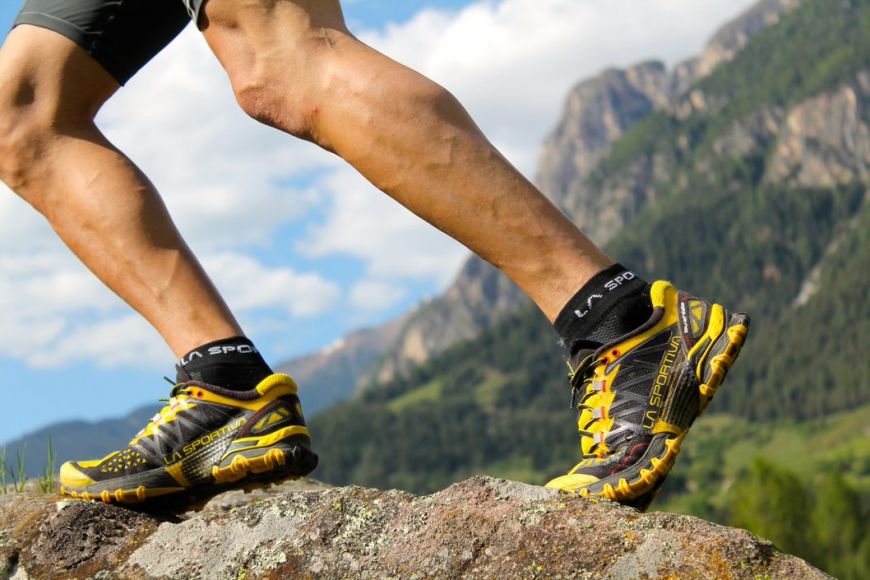
The terrain often dictates the optimal drop. On the road, a medium drop facilitates rhythm. On the trail, protection and stability take precedence: sometimes a more pronounced drop can help on long technical descents. In light mountaineering or approaches, the sole/drop compromise must protect without sacrificing sensitivity.<\/p>
Technical criteria not to forget<\/h2>
The drop is just one parameter among others. The thickness of the sole, the density of the foam, the stability of the heel, the support of the midfoot: everything counts. Knowing how to choose a shoe sole for your specific use allows you to combine comfort and performance.<\/p>
What we test at ALPINSTORE<\/h2>
We are a team of seasoned athletes: we run, we test, we wear out. In our tests, we evaluate cushioning, responsiveness, grip, durability. We look for high-performance running gear that holds up and allows you to chase times without ruining your mechanics. We also look at the running clothing collection to match and optimize thermal regulation.<\/p>
Where and how to buy knowledgeably<\/h2>
If you want to buy running shoes, start by defining your profile: frequency, distance, surface, injury history. Try in-store, take a few strides, and above all keep in mind the transition if you are radically changing drop. For trail, some constraints change: we recommend comparing before wanting to buy trail shoes suitable for varied terrains.<\/p>
Complementary products that make a difference<\/h2>
The shoe is not everything. A quality running gear, suitable insoles, and sometimes poles on certain long outings can enhance your experience. For those practicing Nordic walking, a well-chosen selection of Guidetti Nordic walking poles transforms an outing into a complete workout. And if you have the soul of a climber, you can also look at the offer to buy shoes for climbing and après-ski to have the right pair for each season.<\/p>
Our practical tips for choosing<\/h2>- Test several drops during the same fitting: you will feel the difference right away.<\/li>
- Alternate outings with your old and new pairs for a smooth transition.<\/li> <\/ul>
Concrete cases: who aims for what?<\/h2>
You are a short road sprinter: prioritize responsiveness and a medium drop to energize. You are a long trailer: seek cushioning, grip, and stability, keeping a drop suitable for descents. You are curious about minimalism: progress slowly and strengthen. If the goal is global, equip yourself: quality running gear and high-performance running shoes become your best allies.<\/p>
Quick FAQ<\/h2>
Can you run immediately in zero-drop? No. Do you need more cushioning when changing drop? Sometimes yes, depending on your biomechanics. Where to buy Altra running shoes if you want to test a zero-drop with high stack? Inquire with specialized retailers that allow in-store trials.<\/p>
Conclusion: which drop to choose?<\/h2>
The best drop is the one that respects your morphology, your history, and your goals. At ALPINSTORE, we help you find the balance between comfort and performance. Want to go further? We offer personalized advice, a sharp selection, and support so that each pair becomes a sustainable solution. Come see us, chat with our passionate runner team, and leave with high-performance trail gear or shoes suited to your racing project.<\/p>
How to transition from one drop to another without injury<\/h2>
The golden rule: gradual transition. You decrease the drop in stages, lighten the sessions, strengthen calves and tensor. We recommend trying alternately on short outings and then increasing the duration. Your body adapts, but you need to give it time.<\/p>
Choose according to your use: road, trail, mountain<\/h2>
The terrain often dictates the optimal drop. On the road, a medium drop facilitates rhythm. On the trail, protection and stability take precedence: sometimes a more pronounced drop can help on long technical descents. In light mountaineering or approaches, the sole/drop compromise must protect without sacrificing sensitivity.<\/p>
Technical criteria not to forget<\/h2>
The drop is just one parameter among others. The thickness of the sole, the density of the foam, the stability of the heel, the support of the midfoot: everything counts. Knowing how to choose a shoe sole for your specific use allows you to combine comfort and performance.<\/p>
What we test at ALPINSTORE<\/h2>
We are a team of seasoned athletes: we run, we test, we wear out. In our tests, we evaluate cushioning, responsiveness, grip, durability. We look for high-performance running gear that holds up and allows you to chase times without ruining your mechanics. We also look at the running clothing collection to match and optimize thermal regulation.<\/p>
Where and how to buy knowledgeably<\/h2>
If you want to buy running shoes, start by defining your profile: frequency, distance, surface, injury history. Try in-store, take a few strides, and above all keep in mind the transition if you are radically changing drop. For trail, some constraints change: we recommend comparing before wanting to buy trail shoes suitable for varied terrains.<\/p>
Complementary products that make a difference<\/h2>
The shoe is not everything. A quality running gear, suitable insoles, and sometimes poles on certain long outings can enhance your experience. For those practicing Nordic walking, a well-chosen selection of Guidetti Nordic walking poles transforms an outing into a complete workout. And if you have the soul of a climber, you can also look at the offer to buy shoes for climbing and après-ski to have the right pair for each season.<\/p>
Our practical tips for choosing<\/h2>- Test several drops during the same fitting: you will feel the difference right away.<\/li>
- Alternate outings with your old and new pairs for a smooth transition.<\/li> <\/ul>
Concrete cases: who aims for what?<\/h2>
You are a short road sprinter: prioritize responsiveness and a medium drop to energize. You are a long trailer: seek cushioning, grip, and stability, keeping a drop suitable for descents. You are curious about minimalism: progress slowly and strengthen. If the goal is global, equip yourself: quality running gear and high-performance running shoes become your best allies.<\/p>
Quick FAQ<\/h2>
Can you run immediately in zero-drop? No. Do you need more cushioning when changing drop? Sometimes yes, depending on your biomechanics. Where to buy Altra running shoes if you want to test a zero-drop with high stack? Inquire with specialized retailers that allow in-store trials.<\/p>
Conclusion: which drop to choose?<\/h2>
The best drop is the one that respects your morphology, your history, and your goals. At ALPINSTORE, we help you find the balance between comfort and performance. Want to go further? We offer personalized advice, a sharp selection, and support so that each pair becomes a sustainable solution. Come see us, chat with our passionate runner team, and leave with high-performance trail gear or shoes suited to your racing project.<\/p>
Concrete cases: who aims for what?<\/h2>
You are a short road sprinter: prioritize responsiveness and a medium drop to energize. You are a long trailer: seek cushioning, grip, and stability, keeping a drop suitable for descents. You are curious about minimalism: progress slowly and strengthen. If the goal is global, equip yourself: quality running gear and high-performance running shoes become your best allies.<\/p>
Quick FAQ<\/h2>
Can you run immediately in zero-drop? No. Do you need more cushioning when changing drop? Sometimes yes, depending on your biomechanics. Where to buy Altra running shoes if you want to test a zero-drop with high stack? Inquire with specialized retailers that allow in-store trials.<\/p>
Conclusion: which drop to choose?<\/h2>
The best drop is the one that respects your morphology, your history, and your goals. At ALPINSTORE, we help you find the balance between comfort and performance. Want to go further? We offer personalized advice, a sharp selection, and support so that each pair becomes a sustainable solution. Come see us, chat with our passionate runner team, and leave with high-performance trail gear or shoes suited to your racing project.<\/p>

J'ai acheter deux marques complètement différentes, hoka mach et mizuno 21 avec foulées léger pronateur et j'ai était séduit. Pour course rapide les hoka sont géniale pour une propulsion vers l'avant sans conséquent. Et les mizuno rider21 vers un confort et une légèreté incroyable, pour semi et marathon.